Don't sell a commodity
Why your sports organisation needs a clear why, a real point of difference and a brand people can't get anywhere else.
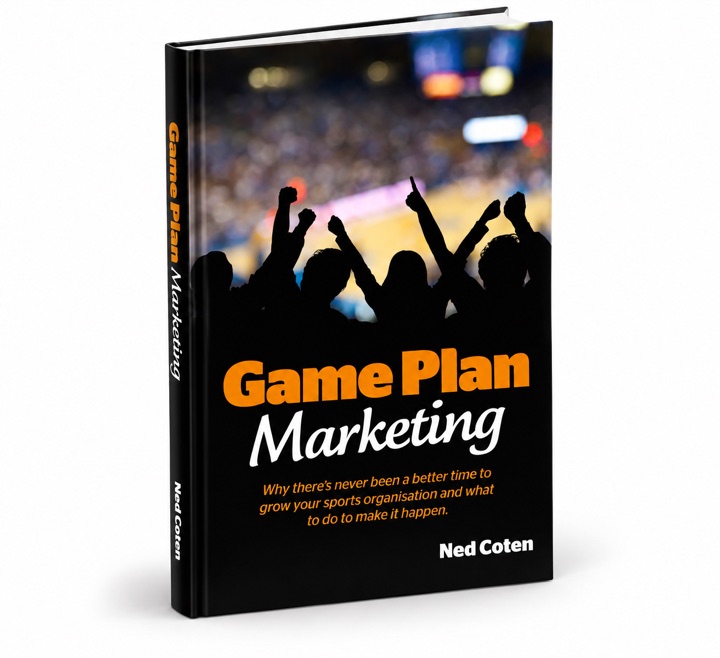
Game Plan Marketing (2013), Ned's book on branding and marketing for sport.
How the world sees sport
When you're involved in something for a long time, you can lose sight of the bigger picture. The way you see things is shaped by your experience, circumstances and beliefs. It's one reason other people often have more faith in us than we have in ourselves.
Unlike a lot of things in the world, sport is seen as positive, engaging, healthy and often exciting. Its stars are admired, and even at the lower levels of any sport there are people others look up to and want to copy. That's good news for your marketing. Starting with a great product is a big help.
One thing sets nearly every sport apart from any other product: passion. For you, sport may be a career. For the people in your sport, it's something they're emotionally attached to and use to get away from their day-to-day worries. Used well, that passion can set your marketing apart.
Start with why
When I first started reading books about how to do things better, I flipped straight to the juicy bits in the middle, where I could quickly learn what to do and how to do it. It took me about ten years to learn that this wasn't the most important part. The part I skipped was the boring stuff: the right mindset, being clear about what I wanted, starting with the end in mind and having a goal that meant something to me. In other words, the why.
When I played, I always wanted to be on the team that really wanted to compete and win, even if it had less skill than its opponents. We called teams with less desire frontrunners. When they were in front and things were easy, they'd win. When the pressure was on in a big game, they couldn't match the desire, the why, of their opponents.
In early 2012 I saw a talk that changed the way I looked at business and life. Simon Sinek's Golden Circle says that why you do something matters far more than what you do or how you do it.
“
People don't buy what you do; they buy why you do it.
SIMON SINEK
It's about 18 minutes long and well worth your time. Watch Simon Sinek's talk.
We only notice what's different
To get attention, you need a point of difference. It might be your target market, the way you engage with customers or the service you provide. A good rule of thumb is to look at what everyone else is doing and do the opposite.
When I ask people what's different about their sporting organisation, I often hear "we provide better service" or "we have great coaches". That's a weak answer. If you don't have great service or great coaches, you can't compete at all. People expect a real point of difference that genuinely sets you apart.
Make sure you're not selling a commodity
If you sell what everyone else sells, it's a commodity, and the only thing you can compete on is price. There's always someone willing to be cheaper. I'm not talking about the product or service itself, but the wrapping around it: the emotion and the experience. In other words, your brand.
Coffee is my favourite example. It's a basic product that could easily be a commodity. I buy a coffee every day, almost always from the same cafe near my office, Vodka, Borsch and Tears. I walk past three other coffee shops to get there. I'm not just buying the coffee.
WHY I WALK PAST THREE OTHER CAFES
I like the people, who know me and use my name.
The coffee is always hot and good. That should be true of every cafe. It isn't.
It has a vibe I like and have grown comfortable with.
They opened an account for me, so I don't need loose change.
It's close enough to walk to, but not too close, and I know some of the other customers.
And some reasons I can't put into words. It just feels right.
Even when I'm away from the office and craving a coffee, I'll wait until I get back. I even have a nickname for it, the Vodka Bar, which says a lot about how attached I am to the brand. They've taken a commodity and built it into a brand. They're always full.
Know exactly what you stand for
A brand can't succeed unless people know exactly what it stands for and what it delivers. Think of Wimbledon, the most prestigious tennis tournament in the world; the City2Surf, the world's largest fun run; the Weet-Bix Kids TRYathlon, triathlons for kids; and the Stawell Gift, Australia's oldest and richest short-distance running race.
Choose a position and stick to it rigorously. Make sure everything you do is consistent with it. If you position yourself as a family venue, don't do things that make families feel unwelcome, even for one day or one hour of the year. The life of your organisation depends on it.
Canteens at sports venues are a good example. How often have you loved the food and service at a venue cafe, then come back to find the complete opposite? One person says it's a nine out of ten, another says it's a six. You can build a brand around either, as long as it's consistent. When it isn't, trouble is around the corner.
Don't make one group pay for another
Too often I see one group of members or participants subsidising another. It's unfair, and it's bad business. You're free to give benefits to people who don't pay for them, but know that it's costing you revenue, and explain it clearly to the people who are paying so they have a choice.
A note on dates
Ned wrote this in 2013 while working on Game Plan Marketing. Some examples are from that time.

I'd love to hear from you
If this article raised a question for you, or you'd like to talk something through, send me a note. I read my own email and reply as quickly as possible, generally within 24 hours.