My career in sport
First written 18 September 2021 · 13 minute read
People often ask me how I got into the sports industry. The honest answer is one step after another, plus a few lessons I learned the hard way.
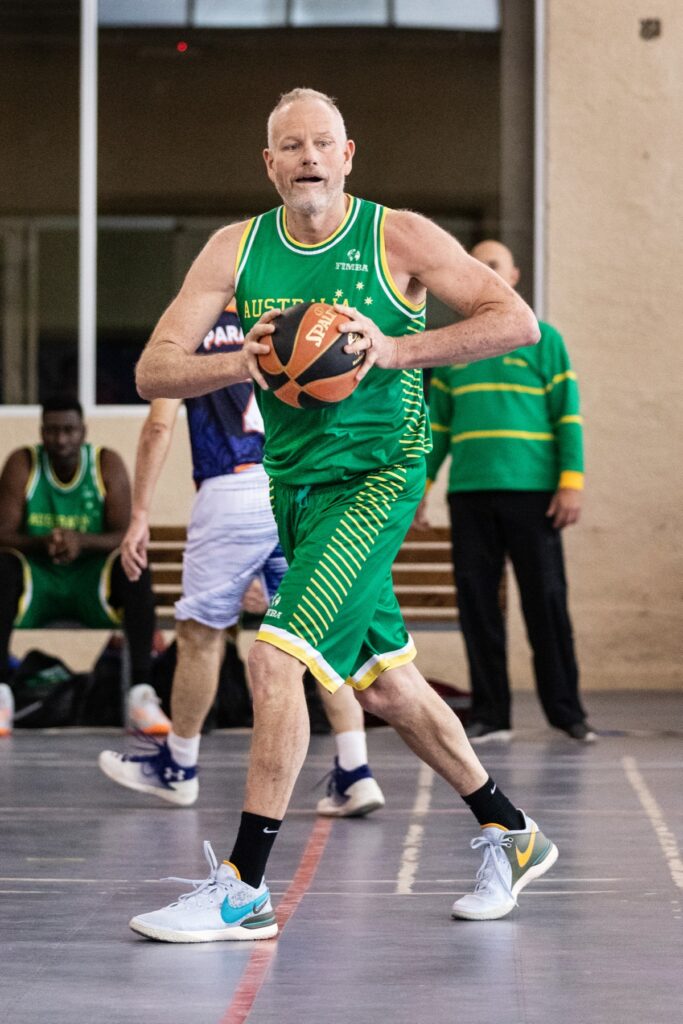
Ned playing Masters basketball for Australia.
A sports nut from the country
A lot of people, particularly younger people, ask me how I got to where I am in the sports industry. I'd never really thought about it. For me it has just been one step after another, and like many people, I took it for granted.
I thought it might help others to see how it happened for me, so I've written it down.
Like many people who end up in sport, I was a sports nut as a kid. I grew up in a small country town in regional Western Australia and played every sport I could. I had a football, a basketball, a tennis racket, a hockey stick, a cricket bat and a bike, and that was my entertainment.
Fast forward through my years as an athlete. My first experience as a sports entrepreneur was running what I'm sure was one of the first 3x3 basketball tournaments in the world. I just thought it would be cool. So I rented a court at Perry Lakes Basketball Stadium in Perth, invited all my friends, charged them $30 a head and ran a competition for a day.
I also ran basketball camps in my home town, and I was always curious about the people I met through my career as an athlete.
My first real job in sport
At the AIS in Canberra, I met a tennis player called Charlie Fancutt. Charlie went on to partner with Paul McNamee and Pat Cash to start the Hopman Cup in Perth. When he arrived, six months before the first tournament, he rang me and said he might need some help.
That became my first real job in sport, at the end of my university years. I worked on anything that needed doing. I didn't really know what I was doing, but I was willing to turn my hand to anything: writing articles, calling the media, setting up grandstands and everything in between. In hindsight, it was a great experience.
Semi-Pro in Kalgoorlie
Charlie was also interested in basketball, and at the time the State Basketball League in WA was expanding. A franchise was available in Kalgoorlie, about 600 kilometres east of Perth in the middle of one of Australia's biggest mining areas, and we struck a deal with the Kalgoorlie Basketball Association.
If you've ever seen the movie Semi-Pro, you'll know what happened next. I moved to Kalgoorlie and became general manager, head coach and a player for the Goldfields Giants, as well as sponsorship salesman, ticketing manager, floor wiper and everything in between. I vividly remember the night before our first game, on the court with a few of my teammates, building the corporate boxes for fans to sit in the next night. Those were great days.
The most rewarding part, and where I found my own piece of gold in Kalgoorlie, was meeting my wife, Hilary. Hilary worked for Gold Corporation (the Perth Mint), which became our major sponsor on the back of my sponsorship proposal. I joke that I put an extra line in the contract, and the rest is history.
A foot in the door at the Wildcats
From there I went back to Perth and, for six months, fell back on teaching. I had trained as a manual arts teacher, teaching metalwork, and I taught at one of the more challenging schools in Perth.
Keen to expand my horizons, I asked the Perth Wildcats if they had any work. They didn't. But the CEO at the time, Vern Reid, wanted more publicity for the team in the local community. I picked up on that and offered to write four articles a week about the players' school clinics and send them to the local newspapers.
It worked. Pretty soon the Wildcats were getting exposure they had never had before. Vern paid me a small amount for it, and on the back of that he invited me to become the team's marketing manager.
That was probably my first major step into sport. It wasn't a planned journey. It just happened. Looking back, I could have been far more structured about what I wanted to do. I was an opportunity seeker, and I simply looked at what was out there.
Learning to lead the hard way
Vern left two years later and his role was advertised. I had to fight hard to win it against some very good candidates, but in the end the chairman, Kerry Stokes, put his trust in me and I became CEO.
It was a difficult learning experience. I was 32 and had never managed anyone. I learned a lot of hard lessons, and after two years I decided it was time to leave Perth.
I took the CEO role at Adelaide City in the National Soccer League. It was a time of turmoil and change in the league, and a very different world from basketball. My first three months in Adelaide felt like a holiday. I met lots of new people and it was exciting.
The next three months were a nightmare. Board meetings every Tuesday ran from 6pm until 11.30pm. There were difficult personalities I struggled to deal with, and infighting among pretty much everyone in the club. I was inexperienced in that environment.
So I moved to Melbourne as CEO of the Victoria Titans, the new team formed from the South East Melbourne Magic and the North Melbourne Giants. Again it was a challenging environment, with people from different organisations coming together. But I had more experience by then, and it was a challenging but enjoyable time.
Burnt out, and a bit lost
I lasted two and a half years at the Titans. By the end I was burnt out. I had been in sport and basketball for 15 years and just wanted to get away from it all.
I didn't have a plan and, to be frank, I was a bit lost. Because my philosophy was to follow my nose, I had no strategy or structure, and I wondered why I hadn't taken more time to think about what I should be doing. Hilary had been telling me I needed to think about the next step, but I was stupid enough at the time to think it would all just work out. Of course, it didn't.
Still, I have always backed myself to get out of a tough situation, and I still do. I think one reason I'm good at it is that I've been silly enough to put myself in plenty of difficult situations over the years through a lack of planning.
Coming back through volunteering
For the next five years I didn't go near a basketball. I stayed away from the sport entirely. I didn't want to think about it. I worked in a few different businesses, including school clothing and design, which led to an investment in that area I still hold.
Over time, the sport I love drew me back. In Perth I had been on the board of Basketball WA while I was Wildcats CEO. What brought me back was an invitation to join the board of the Big V, the state league in Victoria.
I believe volunteering is a critical part of sport, and I still do it today. What you give is what you get. I've been fortunate to be surrounded in sport by many great people who helped me along the way. Now that I have the experience, I think it's important to keep giving back, and I encourage you to do the same.
From that point, my career in sport really took off, even though I never worked in a sports organisation again.
From the Big V to Basketball Australia
After three years on the Big V board, Dan Kirtley, then President of Basketball Victoria, invited me to join the Basketball Victoria board. I hadn't sought the position, although in hindsight I could have done so earlier. If you want to move forward in an organisation, I'd encourage you to consider a role like this.
The sport faced plenty of challenges at the time, but it was growing on the back of years of work right across the game. There was also growing tension between the state and territory organisations and Basketball Australia. Basketball Victoria put me forward for the Basketball Australia board to help mend some of those relationships. My future colleague David Reid was put forward by Basketball New South Wales, and we joined the board at the same time. I was on the board for nearly eight years, four of them as Chair.
It was an amazing time. It's where I cemented my leadership skills, and where I realised that many of the situations I'd thought were so hard were really small steps of preparation along the way.
Leading a national federation like Basketball Australia was an incredible privilege, and also a great stress. As I said to people many times:
“
Basketball is none of my revenue and all of my stress.
NED ON CHAIRING BASKETBALL AUSTRALIA
But I loved it, and it was a great experience.
Where preparation meets opportunity
About two and a half years into that term, I sat down for a coffee with my good friend Tony Hood. We weren't talking about anything in particular, and I asked him what he was working on. He was raising capital for a sports technology business. Over the next hour, we decided I should come into the business as an investor and possibly as CEO.
You could see that as a random meeting, a chance that might have floated by if not for our coffee. A real sliding doors moment. But looking back, it was where preparation meets opportunity.
I had spent close to 30 years building skills in sport, business, leadership, marketing and selling. None of it was planned. But as I got older, I realised what my true mission in life was. It didn't come easily, and it evolved over a long time.
The CEO role at EngageRM has been the most rewarding of my career by some margin. We have an incredible business with a great culture. But the main reason I'm enjoying it so much is that I'm fully prepared.
I have been knocked around, bashed up and had to get back up many, many times. I have been fired. I have been told I'm no good. And I came out the other side. Through the school of hard knocks I picked up the skills to lead the business, and because of that, I feel confident I can lead it well.
I'm still in sport and technology, just not in the traditional way I would have imagined some years ago.
Five lessons I've learned along the way
LESSON ONE
Be open to opportunities
Some people plan and structure far better than I do, and I'd certainly recommend it. But I've found that simply being willing to follow an opportunity has been incredibly rewarding. As you get older, you get better at recognising which ones will be useful and which won't.
Looking back, some opportunities were instrumental. Moving to Kalgoorlie to run a basketball team seemed like a big step backwards at the time. In hindsight, it honed my skills as a leader, a manager and someone who could make decisions on their own.
Joining the Big V board was more work than glory, but it put me in a small spotlight in Victorian basketball and built the profile that led to Basketball Australia. And a coffee with Tony Hood led to the most rewarding professional experience of my life. So don't be afraid to go down a few rabbit holes and explore.
LESSON TWO
Meet people
People make the decisions and provide the opportunities. So it's important to know as many people as you can, or as many as you need, to move forward.
As an athlete, I was always curious about the people around me. I'd talk to managers, coaches and all sorts of other people and ask how they got into their roles, what they did and what they'd learned. I'm sure some of my teammates thought I was a bit of a nerd. I was just curious, and building a knowledge base for the future without knowing what would come of it.
Being genuinely interested in people has been an important thread through my career. One of the most frustrating things I see in sport is athletes, and young people in organisations, not taking advantage of the opportunities around them. They are surrounded by people who love the game or the organisation and would happily spend hours talking about it.
For me, one of those people was Kerry Stokes, who became one of Australia's wealthiest people and, more importantly, is an incredible person. I was fortunate to spend time with him, simply because I was curious enough to ask about his life and what he had done.
LESSON THREE
Always touch the lines
This comes from a basketball training drill. You run the lines, touching the free-throw line, the halfway line, the far free-throw line and the end line, and you have to do it in under 30 seconds. The constant call from the coaches in every team I played for was "touch the line".
I've used it ever since as a reminder: if you're going to do something, do it well. I'm not naturally a finisher, and I'm not detail-oriented. I'm a big-picture thinker who often forgets the small details, and I like starting things far more than finishing them.
So I've had to learn that it's much better to do less and do it really well than to do lots of things and have a reputation for never finishing. It's the small things you do when no one is watching, always touching the line, that make the difference. Over months and years, people notice. You build a reputation as someone who gets things done, and that reputation will take you a long way.
LESSON FOUR
Build confidence
Confidence matters in any role, and it's hard to get. As humans, we're quick not to trust ourselves. The animal brain in our heads keeps telling us why something can't be done, or that we're not good enough. I've heard those voices and battled them many times.
People often say you just need to get rid of the voices. I don't find that easy. I'm certainly not a psychologist, but what helped me was to keep going forward while the voices talked in the back of my head. If you're not feeling confident about something, go and do it, or do something else. Be busy. Don't sit around thinking about it. The more you do, the more skills you build, and that builds confidence.
For many years, even though I had some talent, I didn't back myself, and it held me back. If I could change one thing, it would be to back myself sooner, knowing that nobody else is sure of themselves either. The people who succeed have simply decided to do it anyway.
After many failures, I now know I can do things, and I'd back myself in any situation. I don't always know what I'm going to do, but I know I'll be creative and determined enough to find a way forward.
LESSON FIVE
Look in the mirror
This is perhaps the most important lesson of all. You have to understand yourself: what kind of personality you have, what you're naturally good at, what you like and what you don't.
There are plenty of personality tests, and I've done most of them over the years. You don't need them to understand yourself, but I'd recommend them if you're not sure. As you build a picture of yourself, be honest about your strengths and weaknesses. Admit that you're not good at everything, and that some things are better done by other people.
I learned this the hard way, by thinking I could do everything when I really couldn't. Some of it comes naturally with age, but I'd encourage you to ask the people around you for honest feedback on what you're good at, what you're not and how they see you.
We walk around the world doing many different things, but we really live our lives in our heads. It's important to get your head straight and think things through. There's no great secret. You just have to work on it over time and, in the end, be honest with yourself.
I've been incredibly fortunate to meet amazing people and to have some significant opportunities. But in writing this, I've realised it was the result of a process. I decided I wanted to go out and do great things in the world, and I followed my nose until I got there.
It's not everyone's path, but it worked for me. I hope you find yours, and succeed in all that you do.
A note on dates
Ned wrote this in September 2021, when he was CEO of EngageRM. He has been Executive Chair since 2024.

Ned Coten AM
Executive Chair of EngageRM, Chair of the Confederation of Australian Sport and Chair of Basketball Australia from 2017 to 2021. He still plays Masters basketball internationally.
Working out your own next step?
If this story raised a question about your own career, send me a note. I read my own email and reply as quickly as possible, generally within 24 hours.