Sport needs one voice
My speech to close the first NSC Sports Investment Summit in Sydney: what the industry heard, what it needs, and why it has to start speaking as one.
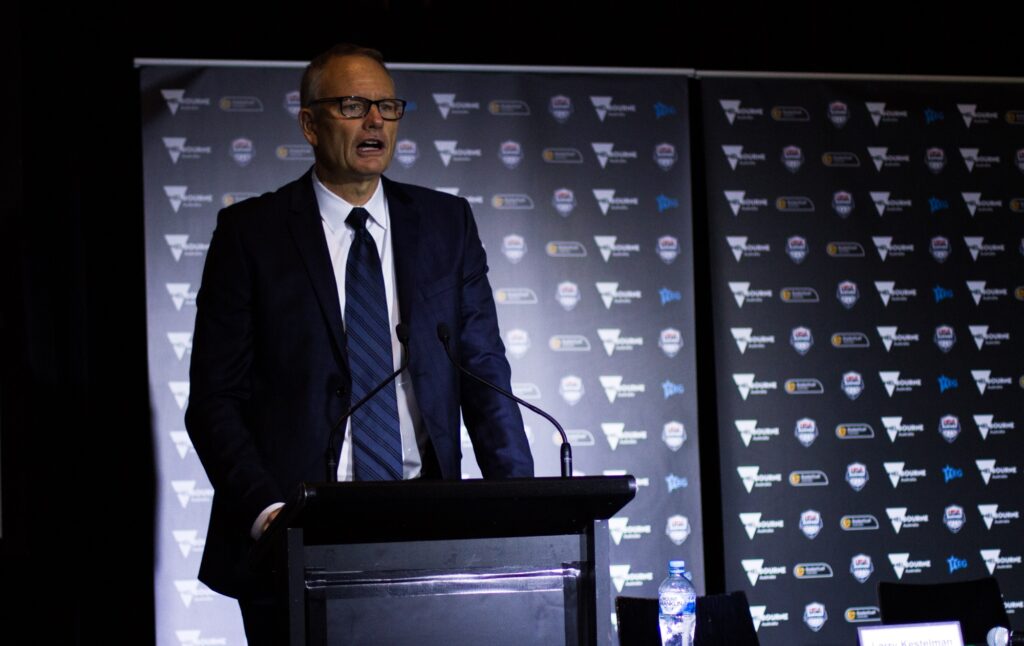
Ned Coten AM speaking to the media.
Colleagues and friends of sport,
With everything going on in the world, it should be clear to all of us that humanity has never needed sport more than it does now. My message today is that we must be its custodians, and make sure our industry and our culture are sustainable and thrive.
Sport is a game changer
That message ran through me on Monday evening at the Sport Australia Hall of Fame dinner in Melbourne. It was an incredible night, and if you've never been, you should book your tickets for next year. Australia's greatest sporting heroes were there, and eight new members were inducted. There were many tears of joy in the room.
Two of the inductees said things that matter to all of us here. The first was Liesl Tesch, now a Member of the New South Wales Legislative Assembly. She played basketball at three Paralympics, then switched to sailing for two more, and won five Paralympic medals, including two gold. After becoming a paraplegic at 19, she simply decided to get on with it, and sport kept her going. Asked about her life's achievements, she said, "Sport is a game changer."
It was for her, for everyone in the Hall of Fame, for all of us and for millions of Australians.
The second was Gerry Ryan, who has invested more in sport than just about any other non-athlete. He founded the GreenEDGE cycling team and has backed AFL, rugby league, basketball and racing, with a Melbourne Cup to prove it. Asked why he contributes, his answer was simple: "Sport is such an important part of the Aussie DNA."
What we've heard
Over the past two days we've delved into sports financing, explored new investment strategies and made connections that can shape our industry. Thank you all for being here. In my view, the greatest legacy we can leave on the road to Brisbane 2032, and the Commonwealth Games, world championships and other events before it, is a thriving, sustainable sports industry off the field as well as on it.
It doesn't matter which part of the sector you come from, or whether your goal is altruistic, commercial or capitalistic. Everybody must be on the train together, and today it has left the station.
My thanks to our international speakers, who gave their time and expertise to help us win, even though I know they're scheming to beat us. Such is the ecosystem of sport. A special thanks to Sally Munday, Chief Executive of UK Sport, and Tim Hollingsworth OBE, CEO of Sport England, for their insights into financial sustainability. And to Matt Carroll of the Australian Olympic Committee, Cam Murray of Paralympics Australia and Craig Phillips of Commonwealth Games Australia, whose discussion showed how closely innovation and funding are linked.
What we've heard is that the global sports landscape is changing fast, with challenges and opportunities for investors and stakeholders alike. Three trends stand out.
TREND ONE
Leagues are going global
Leagues are expanding into new markets and audiences. The International Cricket Council, for example, chose to play 16 of the 55 matches of its men's T20 World Cup in the United States.
TREND TWO
Digital is changing media rights
Digital platforms have transformed how sport is broadcast and how fans engage. Netflix, Rakuten and Amazon bring new revenue and new ways to grow sport.
TREND THREE
Investors are arriving
The link between sport and digital platforms is reshaping the business of sport, and the sports asset class is attracting institutional investors like never before.
For Australian sport, those trends are opportunities: to reach international fans and investors, to use digital platforms for more personal fan experiences and new revenue, and to attract institutional and philanthropic investment by showing we are financially sustainable.
The challenge in front of us
Brisbane 2032, or as Paralympic legend Louise Savage put it yesterday, "the Paralympics and the really cool warm-up event", is an unparalleled opportunity. But to make the most of it, we need to move beyond silos, share resources and build an investment ecosystem that supports every level of sport, from grassroots to elite.
The panel last night was blunt. Government funding will decline, and if you don't run sport like a business it goes backwards. The industry isn't in good shape for the future. Most sports need help to become commercial. As Matt Carroll said, we need to think and act as a business. We have challenges, but together we can solve them.
Why sport needs one voice
The Confederation of Australian Sport has played a vital role since 1976, giving sport a unified voice with governments. It began with 42 sporting organisations and by the mid-1980s represented 123 affiliates and 5.8 million Australians. Its membership has since declined, and many in the industry don't know its work. A dedicated board and our CEO, Rob Bradley, have kept that work going, but largely under the radar.
I joined CAS as Chair and President after finishing my time at Basketball Australia, determined to amplify its impact. Like many of you, I work in other industries too, in my case storage, aged care, brand strategy and technology. Every one of them, and others such as banking, healthcare and mining, has an independent, strong and aligned industry body that speaks for it to stakeholders, investors and government.
Sport doesn't. We have many great organisations representing parts of the industry, and their work has underpinned our success. May that continue. But we can be better. For all the trips we collectively make to Canberra, many politicians see our industry as disorganised and unaligned. Every industry wants more government funding. The others have done something meaningful about it.
Look at the Victorian Government's treatment of our industry, and not just the Commonwealth Games. It affects all of us. Trust diminishes, resources shrink and opportunity drains away, and Australia's reputation for delivering events has been tarnished. Where was the aligned industry response? With almost everyone reliant on government funding, there was no independent body to stand behind.
This isn't only about government money, but it's a window into our industry that should make us all think. Markets such as the United States rely far less on government and have embraced commerciality like never before. Australia is different in many ways, but let's learn from others and take charge of our future.
My thinking
POINT ONE
Sport creates impact
In health and crime prevention, community development, pathways to podiums, better places to live, economic impact and much more.
POINT TWO
Sport can attract investment
And provide economic returns. We need to give investors a stable ecosystem, and learn from each other.
POINT THREE
Sport can deliver for government
It can align with and deliver on governments' wider policies, as it does around the world. We can help them see sport as more than competition.
POINT FOUR
Sport needs a broader definition
As in Europe and North America: movement, participation for its benefits, pathway development and podium success, bringing government, business and all of sport together.
POINT FIVE
We need an industry-wide voice
To represent sport and help it embrace all of this. That's why CAS invested significantly to make this summit happen.
POINT SIX
CAS wants to help create that voice
CAS doesn't have to be that voice. But we do need it.
I believe CAS could be that body. It's independent, has good income and a history of impact. But it doesn't have to be CAS. Perhaps there's too much baggage, or other reasons it shouldn't be.
To be very clear, there is no political agenda here, from CAS or from me. I'm not driven by titles or recognition. If it was decided that we'd have more success if I got out of the way, I would gladly do so. I just want us to be better.
We won't solve this today, but we need to solve it. I'm calling on everyone here to help build an industry with true unity and alignment, one that can drive sport forward in a sustainable, commercial and focused way.
What will we do with it?
I'll finish with my favourite words from the Hall of Fame dinner. They came from Michael Milton, who was named a Legend. He lost his leg at nine, but was determined to keep skiing with his family. By 19 he had won gold at the 1992 Albertville Paralympics. He went on to compete at six Paralympics, winning six gold, three silver and two bronze medals, plus 11 world championship medals. He has survived cancer three times. Not satisfied with that, he set out to break the world speed skiing record, reaching 213km per hour, on one leg.
He was asked how he'd achieved all this after such a challenging start. His answer should resonate with all of us.
“
It's not what you get dealt in life. It's what you do with it.
MICHAEL MILTON
So let's ask ourselves: what are we going to do with it? Let's commit to a united vision and build a legacy where Australian sport thrives and inspires future generations. The time to act is now, and the responsibility rests with each of us.
Thank you.
About this speech
Ned gave this speech in late 2024, as Chair of the Confederation of Australian Sport, to close the first NSC Sports Investment Summit in Sydney.

I'd love to hear from you
If this article raised a question for you, or you'd like to talk something through, send me a note. I read my own email and reply as quickly as possible, generally within 24 hours.