The future of Australian sport
Australian sport is brilliant on the field and fragmented off it. Why I believe a unified voice will deliver a stronger industry.
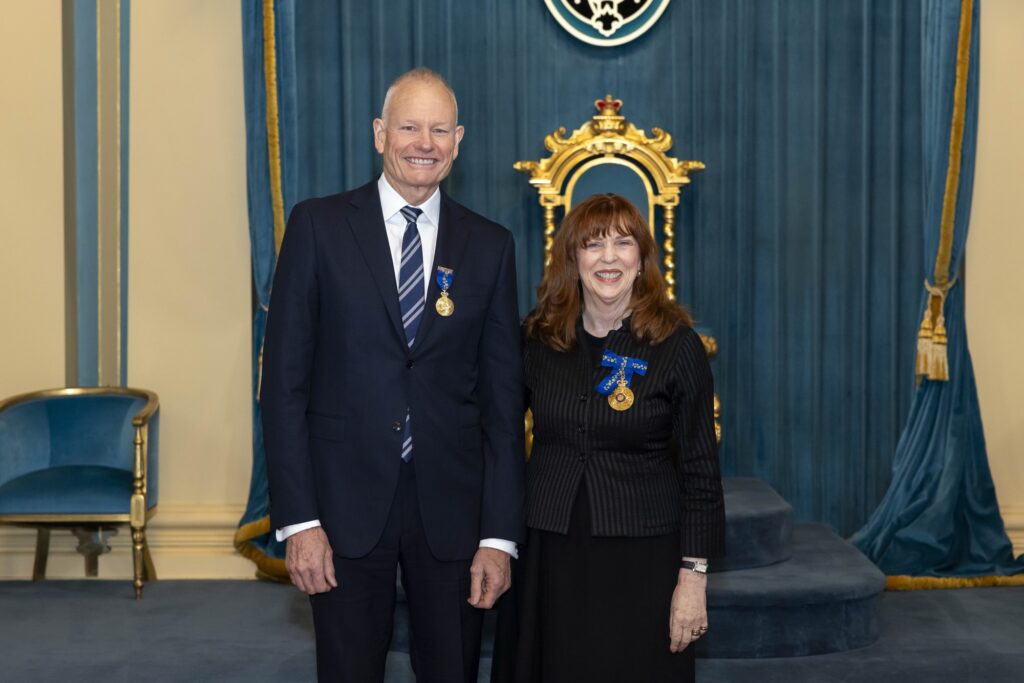
Ned at his investiture as a Member of the Order of Australia, for significant service to sports administration and to basketball.
Sport has been an integral part of my life for more than five decades, beginning as an athlete and evolving into roles as an administrator and volunteer. It has given me immense physical, mental and emotional benefits, and I have seen its transformative impact on individuals, communities and society at large.
Many of my personal, social and business relationships have come from sport, and I'm eternally grateful for its impact on my life. My desire to give back comes from this. I want future generations to have the same opportunities and experiences that I did.
My journey in sports administration began with basketball. After working and volunteering in the sport for more than 25 years, I joined the Board of Basketball Australia in 2014 and later served as its Chair. During that time, I focused on growing the sport, fostering collaboration and creating opportunities for players, officials and administrators alike. Working with colleagues across many sports deepened my understanding of the broader industry and its challenges.
One key insight from those years was that the sports industry tends to operate in silos. It lacks the cohesion of industries such as healthcare, transport and finance, which have unified bodies that advocate for their collective interests. Sport struggles to present a consistent, organised voice to governments and stakeholders.
This fragmentation has real consequences. Governments often see the sports sector as disorganised and reactive. I became determined to close that gap, and to help build a united industry that advocates for its growth cohesively and strategically. That led me to the Confederation of Australian Sport (CAS), where I saw an opportunity to build on a proud history and bring the sports community together.
A strong legacy of advocacy
CAS has played a vital role in Australian sport since it was established in 1976 to give the sports community a unified voice with governments and key stakeholders. It launched with 42 sporting organisations and by the mid-1980s represented 123 affiliates and 5.8 million Australians.
Its influence was particularly strong after Australia's performance at the 1976 Montreal Olympic Games, which showed the need for a national sports strategy. Over the decades, CAS has helped deliver significant public policy outcomes, represented the views of the sector and raised the profile of community sport.
Despite this history, membership gradually declined, and many in the industry today don't know its work. For the past few years, CAS has been run by an extremely dedicated board, working with Chief Executive Rob Bradley, the former Chief Executive of Royal Life Saving Society Australia. It has continued to make a valuable contribution, but it has flown under the radar of much of the industry.
Recognising its potential to unify and strengthen the industry, I joined CAS with a commitment to amplify its impact. I'm not driven by titles or personal recognition. Whether I serve as President or in any other role, my focus is on building a better future for Australian sport. If it was decided that we'd have more success if I got out of the way, I would gladly do so. My focus is the outcome. I just want us to be better.
The challenge of fragmentation
The Australian sports sector is made up of thousands of organisations at every level, sometimes at odds with each other even within the same sport. They often make separate and sometimes conflicting cases to government, which creates an impression of disorganisation. I've had conversations with politicians who love sport and who lament our collective inability to work together.
The Australian Sports Commission has worked hard in recent years to bring about alignment, and we should be thankful for what it has achieved. But as a government-funded body, it can't bite the hand that feeds it. The Australian Olympic Committee, Paralympics Australia, Commonwealth Games Australia and others do incredible work for their members. Yet no group provides comprehensive, independent representation for the whole sector.
That limits our ability to argue for consistent policies, funding and initiatives that benefit everyone. The larger sports in particular, under the Coalition of Major Professional and Participation Sports (COMPPS) model, attract government, private and business funding, and I applaud them for it. But I believe a more collaborative model would mean more for all.
It's possible that the unified voice could be CAS, but I'm in no way wedded to that. If we can find a better way to collaborate, I'll be the first to support it in every way I can.
A vision for unity
The Brisbane 2032 Olympic and Paralympic Games are an extraordinary opportunity. They can showcase not only elite performance but the broader social, economic and health benefits of sport. To make the most of them, the whole industry, including sports that won't be at Brisbane 2032, needs to collaborate more effectively off the field.
A unified, independent organisation representing all national sporting organisations and stakeholders could align strategies, streamline advocacy and present one voice to government. CAS has a strong record of advocacy, sustainable income from activities such as the Australian Masters Games, and a strong network across the industry. But what matters most is that sport unites behind a shared vision.
A record of international success
Australia has a proud history of outperforming much larger nations at the Olympics, Paralympics, Commonwealth Games and world championships, often as the underdog against the United States, China and the European powers.
That success rests on our volunteer-driven sporting system. In many countries, coaches and administrators are paid from the grassroots up. Australia relies on a vast network of volunteers, which means young people can take part regardless of skill or money. Athletes aren't cut early. They're placed in competitions that suit their ability and develop at their own pace.
Basketball shows how well this works. In the 1950s and 60s, volunteers built the facilities and the participation base. By the 1980s and 90s, the NBL and WNBL were thriving. Today Australian players excel in the NBA, the WNBA and at world championships, the legacy of decades of volunteer effort.
To keep that going, we need the support a united approach brings. With rising migration and the growth of technology, sport has to fight for its place in society more than ever. Let's make it easier by being on the same page in our vision and strategy, particularly when it comes to government funding.
A call to action
For me, this is personal. Sport has enriched my life in countless ways and introduced me to incredible people and experiences, and I want future generations to have the same.
Brisbane 2032 is a once-in-a-lifetime chance to show the power of sport to unite and inspire. To seize it, the time has come for national sporting organisations and stakeholders to set aside their differences and focus on what we can achieve together.
“
Let us create a future where Australian sport is as strong and cohesive off the field as it is on it.
NED COTEN
By uniting behind a single voice, we can build a legacy of collaboration, growth and success for generations to come.
Where this first appeared
This article was first published in Australasian Leisure Management, issue 165, in December 2024. Ned is Chair of the Confederation of Australian Sport.

I'd love to hear from you
If this article raised a question for you, or you'd like to talk something through, send me a note. I read my own email and reply as quickly as possible, generally within 24 hours.